Branding
Crypto Branding: 7 Principles to Build Trust (+ Real Case Study)

Branding in crypto is tough, because before anything else you must create trust. Here are 7 principles to help you become a recognized company.


After several years supporting blockchain and crypto projects with their brand strategy, I've observed a pattern that keeps repeating: the best products often fail because of weak branding.
Recently, we completed the full branding of Darika, an exchange platform revolutionizing forex through stablecoins. Still a stealth project, but one that perfectly illustrates why branding isn't optional in crypto.
Why this article?
Because in a sector plagued by scams, unrealistic promises, and repeated scandals, trust isn't proclaimed: it's demonstrated.
And branding is precisely the language that allows you to demonstrate it.
What you'll discover:
- Why crypto naturally inspires distrust (and how to reverse that perception)
- 7 concrete principles to build a credible crypto brand
- Visual examples from our work with Darika
- Fatal mistakes that destroy trust (and how to avoid them)
Whether you're launching a crypto project, a new fintech, an exchange platform, or any other product, these principles apply.
The crypto paradox: solid technology, catastrophic image
Let's start by saying things as they are:
- an overwhelming majority of crypto projects fail or are fraudulent
- scandals, scams, or unrealistic promises have deeply marked people's minds
- for the general public: crypto = risk / scam
And yet there's a total paradox: cryptography itself is one of the most complex and rigorous mathematical fields that exists.
The problem isn't the technology, as it requires years of study and practice—it's what we do with it and how we show it.
To this is added a key factor: crypto now evolves in one of the most regulated environments: finance.
- Licenses are multiplying, and countries are increasingly regulating fintechs, neobanks, market makers, exchanges, etc.
- Compliance constraints and requirements are more strict than ever
- And transparency requirements are high
The new European MiCA regulation has already ended the activity of many companies unable to adapt.
This context reinforces a simple truth → trust is no longer a competitive advantage, it's a survival condition.
1. Why crypto is naturally frightening
Let's be honest. For most people, crypto is scary. Because everything in the ecosystem triggers warning signals:
- The instability of cryptocurrency prices
- Complex concepts that are difficult to explain
- Scandals and unrealistic promises. The Argentinian $Libra is just one example. (the $Libra affair in Argentina)
- Unreassuring interfaces
When it comes to money, the brain seeks only one thing: security. And when it's not completely understandable, it protects itself and therefore doesn't act.
The fear of crypto is therefore not trivial—it's a logical reaction.
The role of crypto branding is not to CONVINCE, it's to make real mastery PERCEPTIBLE.
2. Extreme transparency: show, don't tell
Many projects say they're transparent. Few actually show it.
The brands that build trust aren't those that say "trust us" but those that show:
- the real user journey
- what they can do at each step
- what they can't do
- and what risks they're actually taking
Transparency reassures because it puts control back in the user's hands.
In short, a brand that clearly explains how it works sends a simple message: We have nothing to hide. And in crypto, this message is worth gold 💛!
But concretely, how can you be more transparent?
- Synthesize your messages: not everyone has time to understand you and get to the heart of the matter. A clear and direct message is 15 times more effective than a long, complex sentence.
- Get to the heart of the matter when asked: make your key information more accessible in FAQs, for example
- Have a visual identity that adds value: adopt a brand image that facilitates understanding of your activity rather than a purely aesthetic exercise.
- Adopt a more human, less technical language. Not everyone is able to understand you, and that's normal—meet your audience at their level.
Without good crypto branding, transparency remains theoretical. With clear branding, it becomes understandable.
3. Never overpromise or overcommit
Most crypto scams have one thing in common: they promise unrealistic returns. (We've even seen up to 32% ROI, can you imagine...)
Conversely, credible brands:
- Refuse to promise disproportionate gains
- Clearly explain possible scenarios
- And set a clear limit
But above all, they show it visually by avoiding aggressive visuals with a euphoric tone and anxiety-inducing CTAs.
Fintech and crypto branding serve to regulate discourse and to calm, structure, and credibilize.
4. Brand image: simplicity, lightness, and clarity
In crypto, many think that:
- complex = credible
- technical = serious
It's often the opposite. A simple brand image reduces mental load, facilitates understanding, and increases trust. Simplicity isn't naivety—it's precisely proof of mastery.
"The ultimate sophistication is simplicity," said Leonardo da Vinci.
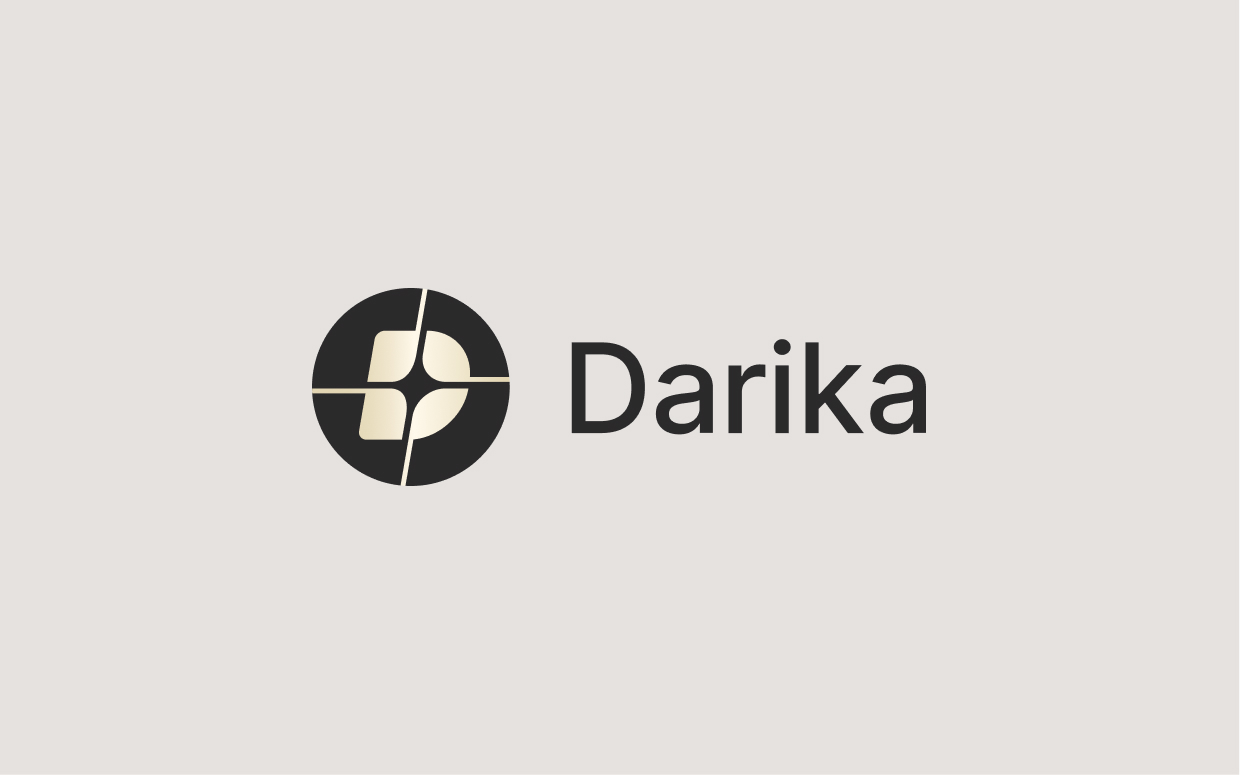
For example, the logo designed for one of our clients, Darika, perfectly illustrates this principle of simplicity. Darika is an exchange platform that reduces the cost of forex by relying on stablecoins.
This promise is found directly in its visual identity: A clean "D," crossed by continuous lines that symbolize fluid, bidirectional, frictionless exchange. The logo doesn't seek to impress. It seeks to make people understand, at a glance, the nature of the product and the fluidity of its operation.
5. Explain simply what you do
A universal rule: if someone can't clearly explain what you do, it's because they haven't understood it. In crypto, this is even more critical.
In a few seconds, a user must be able to answer four simple questions:
- What is it, concretely?
- Who is the product for, and who is it not for?
- In which situations should it be used (and when not to use it)?
- In what context will the user actually use it?
And this is precisely where branding comes in: it allows you to summarize the essentials without oversimplifying.
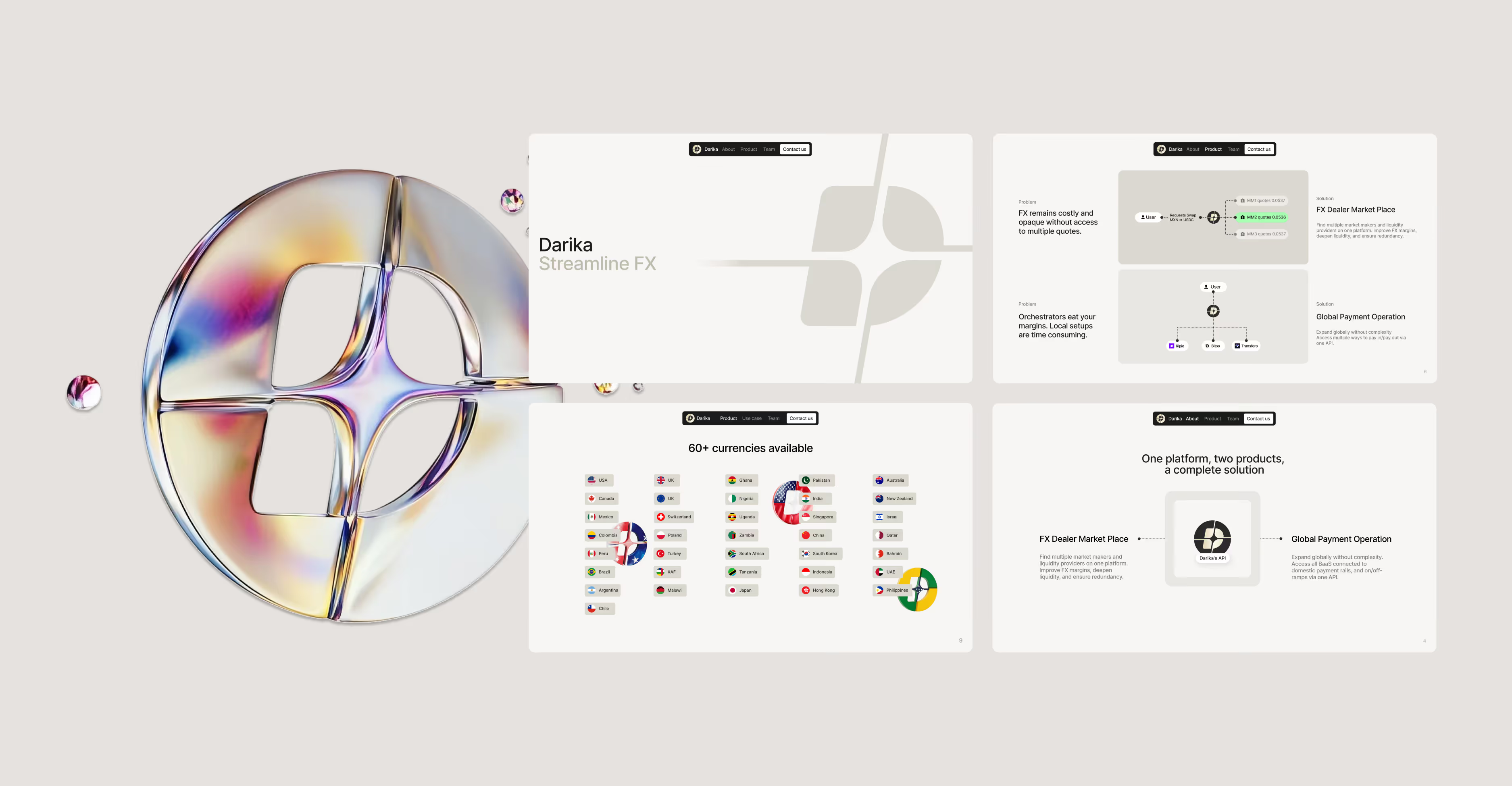
Practical case: Darika's sales deck
At a glance, you understand what it's about: a platform that optimizes currency exchange operations through stablecoins, designed for fintechs and cross-border companies facing the costs and complexity of traditional forex. Everything is immediately readable: who it's for, in which cases to use it, and in what environment.
Branding doesn't seek to seduce. It serves to clarify.
This is exactly the role of effective branding: structure information, prioritize messages, and enable understanding, in a few seconds, what Darika does, for whom, and in what context to use it.
6. Customer feedback - customer experience, examples that worked
One of the most important points is to make proof visible. Indeed, stories are no longer enough users want to see customer feedback, real use cases, and concrete examples.
Seeing that others are already using a product instantly reduces fear: they're no longer afraid of being the first.
Written testimonials are no longer sufficient: they can always be questioned.Favor video interviews with your customers and share them.
7. Be active regularly (without unnecessary noise)
An absent brand worries. An inconsistent brand tires. But a consistent brand REASSURES.Being active doesn't mean publishing continuously.It means:
- Being present
- Being recognizable
- Being consistent
Branding ensures this visual and verbal continuity and transforms each communication into a signal of stability.
Conclusion: branding as a trust infrastructure
In crypto, trust doesn't rely solely on technology or regulation. It relies on a brand's ability to make these elements visible, understandable, and credible.This is precisely THE ROLE of branding.
It doesn't artificially create trust-it allows real trust to exist in the user's mind. In a naturally anxiety-inducing ecosystem, branding becomes a strategic lever: the one that transforms complexity into clarity, and clarity into adoption.
In crypto, trust isn't proclaimed. It's demonstrated.And branding is the language that allows you to demonstrate it 🚀
Launching a crypto or fintech project?
At The Bract Agency, we support blockchain projects in building visual identities that inspire trust.
👉 Let's talk about your project
FAQ: Crypto Branding
Why is branding crucial in crypto?
Because trust is a survival condition. In a sector plagued by scams, a clear and credible identity makes all the difference.
How long does a crypto branding project take?
Between 4 and 6 weeks, depending on complexity: visual identity, website, marketing materials, brand guidelines...
What are the pitfalls to avoid in crypto branding?
The 4 fatal mistakes:
- Overpromising unrealistic returns
- Using incomprehensible jargon
- Neglecting transparency
- Adopting an overly aggressive aesthetic
What types of projects does The Bract work with?
We support exchange platforms, DeFi projects, stablecoins, wallets... Any crypto/fintech project seeking to build lasting trust.



%20(1).jpg)
